
Skip to content
PRO-tec Air Vault
Why Air Vault

Outdoor Car CoverVSPro-tec Air Vault

A traditional fitted car cover used on a vehicle does one thing with remarkable consistency: it traps moisture against the paint, holds dust and grit against the clear coat, and flaps in the wind until it abrades the paintwork.

We give you an honest comparison of outdoor car covers versus our Air Vaults across the factors that matter: UV protection, moisture management, paint abrasion, wind resistance, setup time, and long-term cost.

The goal is to help you decide which solution fits your situation, not to sell you something you do not need.

At a glance

  1. 01

    Traditional car covers block UV light but cannot prevent condensation from forming underneath, which is a direct rust and mildew risk during long-term outdoor storage.

  2. 02

    Car storage bubbles use continuous filtered airflow to keep the interior environment dry, eliminating the trapped-moisture problem that covers create.

  3. 03

    Paint abrasion from covers moving in the wind is a real and underreported source of clear coat damage, especially on vehicles stored outdoors for weeks or months at a time.

  4. 04

    For occasional weekend use, a quality cover may be sufficient. For storage lasting more than two weeks, especially in high-UV, high-humidity, or hail-prone regions, a storage bubble is the more protective choice.

Side by side

Cover or Air Vault?

Outdoor car cover
Pro-tec Air Vault
Contact with paint
Fabric rests on and drags across the paint
Zero contact — only filtered air touches the car
Condensation
Traps moisture against the body panels
Continuous airflow keeps humidity stable
Wind
Flaps in the wind and abrades the clear coat
Sealed, pressurised shell — nothing moves on the paint
Dust & grit
Trapped grit acts like sandpaper
Carbon-filtered air keeps dust out
UV coverage
Gaps at seams and vents; degrades with age
Outdoor PVC shell shields every surface
Hail & debris
Essentially no resistance
Air-pressurised barrier engineered for impact
The problem

How Traditional Outdoor Car Covers Work - and where they don’t.

A car cover is a fabric shell that drapes over the vehicle and, in most cases, ties or straps underneath to stay in place. Quality covers use multi-layer materials that block UV radiation and shed water. At that basic task, they perform adequately. The problems start when the vehicle sits under a cover for an extended period.

The Condensation Trap

Temperature swings cause condensation to form on any surface, including the inside of a car cover. Because most covers create a relatively sealed microclimate against the body panels, that moisture has nowhere to go. According to research published by the Society of Automotive Engineers, surface condensation is one of the primary triggers for undercoat corrosion on stored vehicles. A cover does not prevent condensation. It concentrates it.
Wind and Abrasion Damage

Even a well-fitted cover moves in wind. Each movement drags the cover fabric across the paint surface. Over weeks, that micro-abrasion dulls the clear coat in contact zones, most visibly across the hood, roof, and trunk lid. Owners often attribute that haze to sun damage, but a large percentage is mechanical abrasion from the cover itself.

Sand and grit Under the Cover

No cover goes on over a perfectly clean car every time. Sand, dust, pollen, and debris settle on the paint before the cover goes on or blows underneath. Once trapped between the cover and the paint surface, particles act like sandpaper with every contact. A single sand particle under a taut cover section during a windy day can leave hairline scratches across a panel.

UV Protection: Partial at Best

High-quality covers block a meaningful percentage of UV radiation, but coverage is never complete. Seams, vents, and imperfect fit leave gaps. Covers also degrade. The UV-blocking properties of polypropylene and polyester cover materials deteriorate with prolonged outdoor exposure, meaning a two-year-old cover offers less protection than it did when new. Most manufacturers do not publish degradation curves for their UV ratings.

The solution

How an Air Vault Protects against UV, Moisture, and Paint Damage

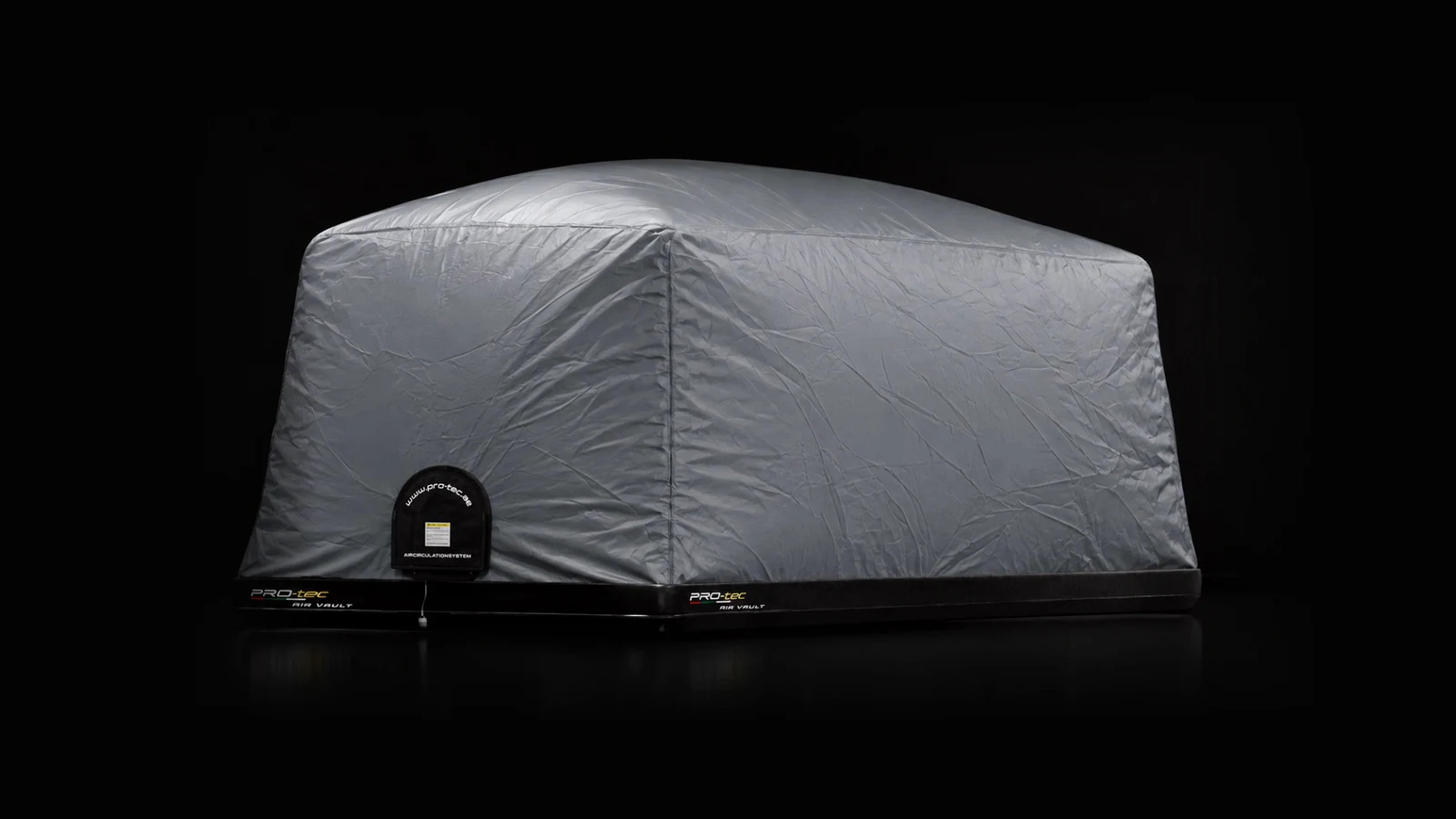
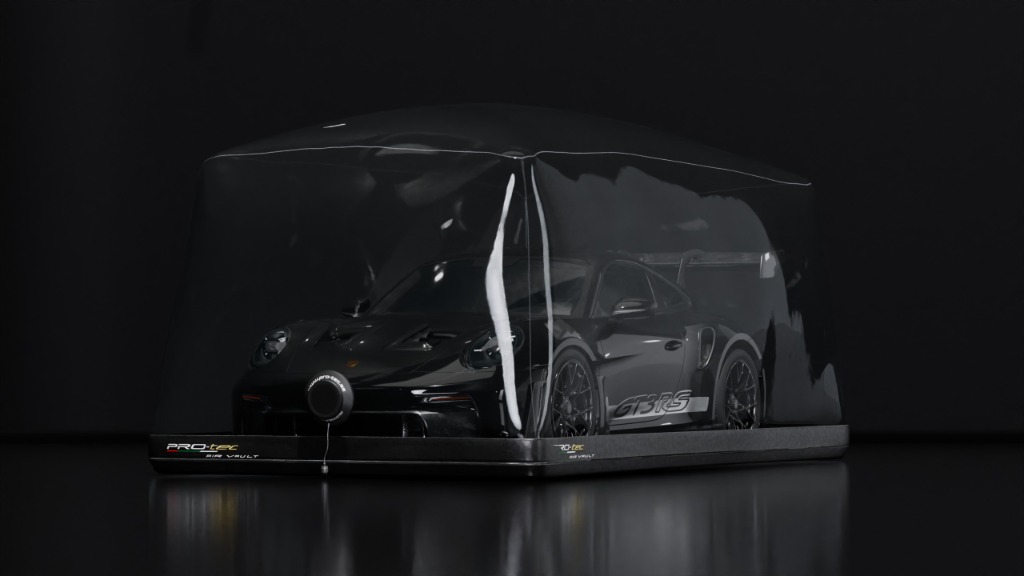
A Pro-tec Air Vault is an inflatable PVC enclosure that surrounds the entire vehicle in a sealed shell. A small brushless electric fan runs continuously to maintain slight positive pressure inside the Air vault and pull air through a carbon filtration system before it enters the vault. This design feature resolves every major weakness of the traditional cover.

Zero Contact with the Paint Surface

The Air Vault does not touch the car. There is no fabric dragging across the clear coat, no grit trapped between a cover and a body panel, and no wind-driven abrasion. The paint surface sits in a controlled environment with nothing touching it except filtered air. For a collector car with a show-quality finish, this is not a minor benefit. It is the most important protection feature available outside of a climate-controlled building, even then there would be dust settle.

Active Moisture Management

The continuous airflow through the filtration system keeps the interior of the bubble at a stable humidity level. Condensation cannot accumulate because fresh filtered air circulates around the vehicle rather than sitting stagnant.

UV Blocking on outdoor Air Vaults

The PVC shell of an outdoor Air Vault is formulated to block UV radiation before it reaches the paint surface. Unlike a fabric cover that relies on woven opacity. The enclosure also protects every surface simultaneously, including the roof, mirrors, and glass, without gaps at seams or vents.

Physical Protection Outside from Hail and Debris

A fabric cover offers essentially no resistance to hail. A vehicle stored in an Air Vault, by contrast, provides a rigid air-pressurized barrier between the vehicle and falling debris. The Outdoor Air Vault is specifically engineered for exterior use offering further direct sun shade, Rain, UV protection. If during winter hail or falling debris protection is a priority, the Air Vault holding a positive pressure environment is engineered specifically for impact resistance.

The goal is to help you decide which solution fits your situation, not to sell you something you do not need.